
- Uttoxeter Rugby Football Club acknowledges its responsibility to safeguard the welfare of all children involved in Uttoxeter Rugby from harm.
- Uttoxeter RFC confirms that it adheres to the Rugby Football Union’s Safeguarding Policy and the procedures, practices and guidelines and endorse and adopt the Policy Statement contained in that document and any successor policy.
- A child is anyone under the age of 18 engaged in any rugby union activity. However, where a 17 year old player is playing in the adult game, (18 or over), it is essential that every reasonable precaution is taken to ensure his safety and wellbeing are protected. (Extracts from rfu policy – refer section A below for further explanation).
- The Key Principles of the RFU Safeguarding Policy are that:
- The welfare of the child is, and must always be, paramount to any other considerations.
- All participants regardless of age, gender, ability or disability, race, faith, culture, size, shape, language, or sexual identity have the right to protection from abuse or harm.
- All allegations or suspicions of abuse, neglect, harm, and poor practice will be taken seriously and responded to swiftly, fairly, and appropriately.
- Working in partnership with other organisations, statutory agencies, parents, carers, children, and young people is essential for the welfare of children.
- Children have a right to expect support, and personal and social development delivered by an appropriately recruited, vetted, and managed in relation to their participation in rugby union, whether they are playing, volunteering, or officiating in the community or professional areas of the sport.
- Uttoxeter RFC recognises that all children have the right to participate in sport in a safe, positive, and enjoyable environment whilst at the same time being protected from abuse, neglect, harm and poor practice. Uttoxeter RFC recognises that this is the responsibility of everyone involved, in whatever capacity, at the club.
- Uttoxeter RFC will implement and comply with the RFU Code of Conduct and the Codes of Conduct for Coaches, Spectators and Officials as appropriate.
- The Club Safeguarding Officer is: Paul Bain, Mobile: 07976461775, Email: pwbain1@outlook.com

If you witness or are aware of an incident where the welfare of a child has been put at risk you must, in the first instance, inform the Club Safeguarding Officer. They will then inform the Constituent Body, CB, Safeguarding Manager and the RFU Safeguarding Team.
If an incident involves the Club Safeguarding Officer, you should inform the URFC Chairman of the Senior or Junior section, and either the CB Safeguarding Manager or the RFU Safeguarding Team.
-
All members of Uttoxeter RFC who work with children in Regulated Activity must undertake an RFU Disclosure and Barring Service (DBS) check in accordance with RFU Regulation 21.
- Uttoxeter RFC will ensure that all its members, whether they are coaches, parents, players or officials will comply with the Best Practice Guidance as issued by the RFU.
In summary, the following are NOT acceptable and will be treated seriously by the club and may result in disciplinary action being taken by the club, the CB or the RFU:
- Working alone with a child.
- Consuming alcohol whilst responsible for children.
- Providing alcohol to children or allowing its supply.
- Smoking in the presence of children.
- Humiliating children.
- Inappropriate or unnecessary physical contact with a child.
- Participating in, or allowing, contact or physical games with children.
- Having an intimate or sexual relationship with any child developed as a result of being in a 'position of trust'.
- Making sexually explicit comments or sharing secually explicit material.
-
Uttoxeter RFC manages the changing facilities and arranges for them to be supervised by two DBS checked adults of the appropriate gender for the players using the facilities. Uttoxeter RFC ensures that all its coaches, parents, officials and spectators are aware that adults must not change at the same time, using the same facilities as children.
-
Uttoxeter RFC will ensure that its coaches [and team managers] will receive the support and training considered appropriate to their position and role. The RFU “Managing Challenging Behaviour” Policy has been adopted and circulated amongst the club workforce both, voluntary and paid.
-
Any events held on Uttoxeter RFC premises must comply with this Policy and if appropriate a Safeguarding Plan should be discussed and circulated to those affected. Any tours, overseas or domestic, undertaken by Uttoxeter RFC must comply with the relevant RFU Regulations and Guidance relating to tours. There may be a number of other points clubs may wish to add to this policy to take into account any matters which are specific to their club, i.e. if it is on a public site there may be additional safety issues. Clubs should not delete any of the above.
This must be adopted in accordance with the club constitution.
Signed: 
Date: 31 August 24
Extracts from RFU Safeguarding Policy with respect to explaining the above URFC Safeguarding policy:
Section A – 17year old players involved in the adult game
This policy covers all players under 18. However, in accordance with the RFU Regulation 15, a male or female player can, with the necessary written consents, play in the adult game when he/she reaches his/her 17th birthday provided:
- they have been assessed as capable of playing with adults;
- the RFU’s Playing Adult Rugby Form has been duly completed and signed; and
- the player does not train or play in the front row of the contested scrum. Once a player has reached the age of 18, the player may play in any position.
Please refer to Regulation 15 for more information: www.englandrugby.com/governance/rules-andregulations/regulations.
A club’s management team must have assessed and continue to assess, that any 17 year old player playing in adult games or training is both physically, emotionally and intellectually capable of taking part. CB approval is required for both club and player prior to a 17 year old taking part in adult contact rugby.)
Section B - Definitions
Regulation 15 -Regulation 15 is the RFU Regulation which deals with Age Grade Rugby and it is advisable for all those working within the children’s workforce in rugby union to read and refer to this regulation regularly. There is also Age Grade Code of Conduct which provides advice and information on all aspects of the children’s game including competitions.
Safeguarding Team - The Safeguarding Team consists of the Senior Safeguarding Manager, Case Manager, Case Officer and Compliance Officer all based at Twickenham, together with local agencies and the Constituent Body, CB Manager. Their contact details are within Section C (below) of URFC policy.
Safeguarding Toolkit - This policy should be read in conjunction with the Safeguarding Toolkit – Appendix A (below) of the URFC Safeguarding Policy which provides further guidance and advice on safeguarding.
Tour Guidance - There is a comprehensive guide “Touring with Children” which contains information to consider when making arrangements for touring with children: www.englandrugby.com/safeguardingtour.pdf
Children - The UN Convention on the Rights of the Child defines a child as anyone under 18. The UK has ratified this convention. For the purposes of this policy this legal definition applies.
Children’s Workforce - Everyone who works with children either as a volunteer or as an employee is part of the children’s workforce.
Disclosure and Barring Service (DBS) - The DBS is responsible for processing requests for criminal records checks, taking decisions on whether it is appropriate to place a person on or remove a person from the DBS Children’s or Adults’ Barred List for England, Wales and Northern Ireland.
Regulated Activity - ‘Regulated Activity’ means the statutory definition of the term as set out in the Safeguarding Vulnerable Groups Act 2006 (as amended) (“SVGA”) that for the RFU’s purposes shall be construed as meaning: any coaching and training of children; and/or any teaching, instruction, care, or supervision of children, carried out by the same person frequently (once a week or more often), or on four or more days in a 30day period, or overnight.
Regulation 21 - Regulation 21 is the RFU Regulation which deals with safeguarding of which all of the children’s workforce in rugby union should be familiar. It details how safeguarding concerns will be managed and also the requirements of the RFU’s DBS process
Section C – Useful Contact Links
|
RFU Twickenham Safe Guarding Team |
Local / Regional contacts |
|
Vivien Rimmer Head of Safeguarding vivienrimmer@rfu.com 0208 831 7832 |
Constituent Body - Staffordshire Rugby Union Safeguarding Manager - Lee Dawson l.dawsonrfusafeguarding@gmail.com |
|
Kath Bennett Safeguarding Case Manager kathbennett@rfu.com 0208 832 7479 |
Staffordshire Police – if a child is in immediate danger or at high risk of harm please phone 999 |
|
Richard Drake Safeguarding Case Officer richarddrake@rfu.com 0208 831 6679 |
Staffordshire Council – Specialist first response team 0800-131-3126 or complete form online |
|
Chris Rawlings Safeguarding Compliance Officer chrisrawlings@rfu.com 0208 831 7454 |
Staffsrfu safeguarding – Kelly Hope srfusafeguarding@gmail.com |
Note - the rfu safeguarding team are not available at weekends. Nevertheless, in the first instance the Club
Safeguarding Officer should report the incident immediately to the rfu and Staffordshire safeguarding Manager. The Club safeguarding Officer should use the incident reporting form and not investigate the incident. The rfu safeguarding team will investigate the incident as appropriate.
Section D – Rugby Core Values
- TEAMWORK
- RESPECT
- ENJOYMENT
- DISCIPLINE
- SPORTSMANSHIP
SAFEGUARDING PROTECTS THE CORE VALUES OF THE GAME.
Section E – Safe Recruitment
The RFU is committed to safeguarding and promoting the welfare of children and expects all staff and volunteers to share this commitment. Children are entitled to participate in rugby union activities in a safe and welcoming environment. Safer recruitment procedures will enable clubs or Constituent Bodies (CBs) to reduce the risk of abuse to children. When recruiting employees or volunteers to the children’s workforce all reasonable steps must be taken to ensure only suitable people are selected.
PAID AND VOLUNTEER STAFF NEED TO BE AWARE OF THEIR RESPONSIBILITIES FOR SAFEGUARDING AND
PROMOTING THE WELFARE OF CHILDREN, HOW THEY SHOULD RESPOND TO CHILD PROTECTION CONCERNS AND MAKE A REFERRAL TO LOCAL AUTHORITY CHILDREN’S SERVICES OR THE POLICE IF NECESSARY. - WORKING TOGETHER TO SAFEGUARD CHILDREN.
Regulation 21 sets out in detail the requirements the RFU has for those working with children and DBS checks. RFU regulations require that any individual who carries out (or who will carry out) Regulated Activity is subject to an enhanced DBS check (with Children’s Barred List information) through their club (using the online e-application system).
Safe Recruitment (Cont)
The people who work in a rugby club are the most important asset a club has. A good and robust recruitment process is essential to ensure the best people are chosen for the roles they undertake. These must be people who are suited to the club and who are unlikely to harm children, intentionally or accidentally. A club which has good recruitment, induction and supervision processes shows those working there the value which is put on children’s safety and wellbeing. A robust recruitment process should always include a job description, interview, consideration as to an individual’s suitability for the role and planning for training and monitoring, in addition to carrying out a DBS check and obtaining and checking references. Official checks and vetting procedures are on their own, not enough to protect children. They are only part of a wider set of practices and an “organisational culture” which supports and promotes safe practice.
Section F – Working Together/Roles & Responsibilities
In order to operate within the legal and regulatory framework, the RFU, its Constituent Bodies (CBs); Staffordshire Rugby, member clubs and other organisations involved in the delivery of rugby will work together, each with a clear role, in order to safeguard children.
The RFU: This policy covers all players under 18. However, in accordance with the RFU Regulation 15, a male or female player can, with the necessary written consent, play in the adult game when he/she reaches his/her 17th birthday provided:
- Appoints a lead officer to manage its safeguarding programme
- Works in partnership with CBs, clubs, police, local children’s services departments and the NSPCC
- Manages the RFU DBS process and notifies the DBS of anyone who is removed, or removes themselves, from working in Regulated Activity because they have engaged in relevant conduct or satisfied the harm test as defined in the SVGA, or received a caution or conviction for a relevant offence
- Co-ordinates a safeguarding programme through a network of volunteer CB Safeguarding Managers (CBSM) and Club Safeguarding Officers (CSO) and provides appropriate training and support to them
- Ensures that there is an up-to-date safeguarding strategy supported by policies, procedures and practices
- Provides training and support for the wider paid and volunteer workforce
- Manages all safeguarding and child protection incident referrals in accordance with RFU regulations and protocols
- Takes disciplinary action against those who breach RFU Regulations
- Provides support and guidance to CBs and clubs on any safeguarding issues, including media or communications activity relating to safeguarding or child abuse issue The CB:
- Appoints and manages a CB Safeguarding Manager
- Ensures that the CBSM has representation or a reporting mechanism within the CB structure
- Ensures that each club running activity for children has its own safeguarding policy reinforcing the RFU Safeguarding Policy and procedures. This should reflect each club’s unique Local Authority requirements.
- Co-ordinates the management of DBS disclosures through the CBSM within the RFU DBS process
- Ensures that all safeguarding concerns are reported to the RFU Safeguarding Team and manages all safeguarding and disciplinary cases referred back to the CB by the RFU Safeguarding Team • Conducts a Safeguarding Audit on a minimum of 10% of member clubs per year
The Volunteer and Employee:
- Works towards creating a safe, friendly and welcoming environment and treats children with respect in accordance with the core values
- Understands and complies with their club’s safeguarding policy
- Follows all guidance in this document when working with children
- Completes any training considered appropriate for their role
- Those members of the children’s workforce working in Regulated Activity are subject to an enhanced DBS check with Children’s Barred List information processed and cleared by the RFU, in accordance with RFU Regulation 21 The Club:
- Appoints a Club Safeguarding Officer (CSO), as the first point of contact for safeguarding and welfare concerns • Ensures that the CSO:
- is a member of, or attends the appropriate club committees making safeguarding issues a priority at the proper level; and
- works in accordance with the Safeguarding Toolkit
- Develops a safeguarding training plan, ensuring that as a minimum:
- the CSO attends an “In Touch” Workshop within six months of taking up the post
- each mini and youth age group has at least one person who has attended the “Play It Safe” course
- Promotes best practice throughout the club
- Completes annual Safeguarding Self Audit by the date highlighted in Regulation 21 • Informs all members, parents and children when a new CSO is appointed
- Publishes the club’s own safeguarding policy which reinforces the RFU Safeguarding Policy and procedures which reflects the unique local circumstances for that club and makes it accessible to all members
- Ensures all club officers and committee members are aware of their safeguarding responsibilities
- Ensures that at any youth disciplinary panel, the CSO supports the child and ensures the panel considers the child’s emotional wellbeing throughout following the RFU Guidance available for achieving best evidence for child witnesses
- Identifies any signs of harm or concerns and reports them to the CBSM and/or the RFU Safeguarding Team
- Ensures that the club’s Children’s Workforce have up-to-date DBS checks in accordance with Best Practice Guidance and Regulation 21
Section G - WHAT IS ABUSE?
Types of abuse - Abuse is maltreatment of a child. Somebody may abuse or neglect a child by inflicting harm, or by failing to act to prevent harm. Children may be abused in a family or in an institutional or community setting by those known to them or, more rarely, by others (e.g. via the internet). They may be abused by an adult or adults or another child or children. There are four main types of abuse: PHYSICAL, SEXUAL, EMOTIONAL, NEGLECT. An individual may abuse or neglect a child directly or may be responsible for abuse by failing to prevent another person harming that child. Bullying is also abusive behaviour which generally incorporates more than one of the four types of abusive behaviour. Those involved with children should be aware that abuse, neglect and safeguarding issues are rarely standalone events that can be covered by one definition or label and in most cases, multiple issues will overlap with one another.
Possible signs of abuse include, but are not limited to:
- the child says he/she has been abused or asks a question or makes a comment which gives rise to that inference
- there is no reasonable or consistent explanation for a child’s injury, the injury is unusual in kind or location or there have been a number of injuries and there is a pattern to the injuries
- the child’s behaviour stands out from the group as either being extreme model behaviour or extremely challenging behaviour, or there is a sudden or significant change in the child’s behaviour
- the child’s development is delayed; the child loses or gains weight or there is deterioration in the child’s general wellbeing
- the child appears neglected, e.g. dirty, hungry, inadequately clothed
- the child is reluctant to go home, or has been openly rejected by his/her parents or carers; and
- inappropriate behaviour displayed by other members of the club or any other person working with children, for example inappropriate sexual comments; excessive one-to-one attention beyond the requirements of their usual role or responsibilities; or inappropriate sharing of images
Section H – Best Practice Guidance
The RFU’s aim is to create a culture where everyone feels confident to raise legitimate concerns without prejudice to their own position. Concerns about the behaviour of coaches, officials or any members of the children’s workforce which may be harmful to a child in their care must be reported to the RFU Safeguarding Team through the Club Safeguarding Officer or CB Safeguarding Manager. While remembering that it is the safety and welfare of children that is of paramount importance, there will be times when those responsible will need to exercise discretion and common sense to ensure their wellbeing.
This guidance is designed to provide information on a number of different topics which CBs, clubs and their volunteers and employees may find useful and will help them to create safe, friendly, and welcoming environments for children.
Safe environments - A safe environment is one where:
- the possibility of abuse is openly acknowledged
- the volunteers and employees are appropriately recruited and trained; and
- those who report suspicions and concerns are confident that these will be treated seriously and confidentially.
Communication is central to maintaining a safe environment; this includes information given to parents at the start of the season (such as the CSO’s name and contact details), choosing the correct and appropriate method of providing information to children (email/phone to parents), listening to children’s views on matters which affect them, as well as considering how to communicate in an emergency (mobile/landline). Messages relating to children, sent via telephone, emails and texts, should be through their parents/guardians. Where appropriate, older players may be copied in but this should always be done by blind copying in order to protect their data. Direct personal communication with children should be avoided at all times, unless there are exceptional circumstances e.g. risk of harm
Recruitment - Clubs should have a suitable children’s workforce and all steps should be taken to exclude anyone who may pose a threat to children. When recruiting new members of the children’s workforce, clubs should ask anyone unknown to the club to provide a written reference, which the club should then verify. Anyone volunteering for a position in the children’s workforce should be provided with a job description setting out clearly their responsibilities and remit.
Training & Monitoring - The behaviour and performance of new volunteers and employees should be monitored for a period to ensure they are following best practice. Clubs should encourage all adults who have a coaching role to attend an appropriate rugby union coaching course and a “Play It Safe” course. This is an introductory level safeguarding course designed for any club members. It is a three-hour face-to-face workshop which provides all those attending with an awareness of safeguarding, as well as the opportunity to share best practice with others. Those wishing to book on to a course should do so, by using the RFU online course booking system available on www.englandrugby.com/governance/safeguarding/ safeguarding-courses
Supervision - To provide a safe environment, clubs should ensure that their volunteers and employees when working with children avoid working in isolation out of the sight of parents or other volunteers. While volunteers and employees are awaiting their DBS disclosure, they must be supervised by someone who does have DBS clearance. Risk assessments should be undertaken to determine whether it is appropriate for a person to commence working with children prior to receipt of the DBS disclosure and what level of supervision is appropriate. They should not work without supervision at any time until their DBS has been cleared by the RFU and they have a green “current” marker on the Game Management System.
Contingency planning should ensure that if a player’s injury requires significant attention, or coaches are absent or away with a team, levels of supervision can be maintained by suitably DBS checked adults. However, in an emergency, the first attention must be paid to an injured player and if there are insufficient suitably DBS checked adults available to supervise the remaining players, clearly, other responsible adults will need to be asked to step in. Parents/carers should be advised that it is not acceptable to drop children off at a club without any adult supervision.
Adult: Child Ratios - There should always be at least one DBS checked adult in charge of any group of children. The RFU recommends a minimum ratio of adult to children of:
- 1:10 for children over 8 years old aged at least 9
- 1:8 for children under 8 years old aged 7 and 8
- 1:6 for children under 7 years old
On Tour - This policy applies equally on tour as at the club. When on tour if an adult is solely there supporting their own child they will not need DBS clearance, but they will if they are acting in any official capacity with other children. This would apply to those on bedtime or other supervisory duties. For more detailed guidance please read the Safeguarding Toolkit and Touring with Children (A Safeguarding Guide) which may be found at: www.englandrugby.com//dxdam/47/47825ee0-5ca7-449fbaad-401e2ef78ae7/safeguardingtoolkit.pd
Inappropriate Relationships with Children - An adult in a position of trust must not enter into a sexual relationship with a child in their care. All adults should clearly understand the need to maintain appropriate boundaries in their dealings with children and young people. Intimate or sexual relationships between those working with children at rugby clubs and a child will be regarded as a grave breach of trust and will be treated very seriously and may result in RFU disciplinary action, including barring individuals from attending rugby clubs.
All adults should ensure that their relationships with children are appropriate to the age and gender of the children, and take care that their language or conduct does not give rise to comment or speculation. Attitudes, demeanour and language all require care and thought, particularly when adults are dealing with adolescent boys and girls.
From time to time adults may encounter young people who display attention-seeking behaviour, or profess to be attracted to them. All adults should aim to deal with those situations sensitively and appropriately but ensure that their behaviour cannot be misinterpreted. In these circumstances, the adult should also ensure that the club’s safeguarding officer is aware of the situation.
Breach of Position of Trust - The sexual offences legislation in the UK already provides that any sexual activity between adults and children under 16 is illegal and constitutes abuse. The primary motivation for legislation which addresses the abuse of positions of trust is the need to protect young people aged 16 and 17 who, despite reaching the age of consent for sexual activity, are considered to be vulnerable to sexual abuse and exploitation in defined circumstances. This includes sexual activity and relationships with adults who hold a position of trust, responsibility or authority in relation to them and, as a result, have a considerable amount of power and influence in their lives. The law defines specific roles and settings where sexual activity between 16- and 17-year-olds and those in positions of trust, responsibility or authority constitutes a criminal offence. Currently being a coach/official in a rugby club is not considered under the law as a specified role. While it may not be a criminal offence in a rugby union setting it will be treated very seriously and may result in RFU disciplinary action, including barring individuals from attending rugby clubs and removing them from their role.
On being notified that an adult in a position of trust is involved or suspected to be involved in a sexual relationship with a child the RFU Safeguarding Team will report the matter to the police. An adult removed from Regulated Activity for engaging in a sexual relationship with a child will also be referred by the Safeguarding Team to the DBS who will consider whether to bar that person from working with children in other environments. No-one in a position of trust should encourage a physical or emotionally dependent relationship to develop between them and a child in their care; this is often referred to as grooming. Adults must never send children inappropriate or sexually provocative messages or images by text, or other electronic media.
On being notified that an adult in a position of trust is involved or suspected to be involved in a sexual relationship with a child the RFU Safeguarding Team will report the matter to the police. An adult removed from Regulated Activity for engaging in a sexual relationship with a child will also be referred by the Safeguarding Team to the DBS who will consider whether to bar that person from working with children in other environments. No-one in a position of trust should encourage a physical or emotionally dependent relationship to develop between them and a child in their care; this is often referred to as grooming. Adults must never send children inappropriate or sexually provocative messages or images by text, or other electronic media.
Safeguarding Children with Additional Needs - Children with additional needs and their families may need more information, help and support. The club’s children’s workforce may require training and advice to ensure they include and safeguard them appropriately.
Good Role Models - The children’s workforce should consistently display high standards of personal behaviour and appearance and refrain from pursuits considered unhealthy in front of their players. They must not make sexually explicit comments to children and any language which causes them to feel uncomfortable or lose confidence or selfesteem is unacceptable, as is the use of obscene or foul language. Alcohol It is important that all rugby clubs’ management committees take considered, positive action to ensure that they are responsible licensees.
It is against the law:
- to sell alcohol to someone under 18;
- for an adult to buy, or attempt to buy, alcohol on behalf of someone under 18;
- for someone under 18 to buy, attempt to buy, or to be sold alcohol;
- for someone under 18 to drink alcohol in licensed premises, with one exception - 16- and 17-year-olds accompanied by an adult can drink but not buy beer, wine and cider with a table meal; or
- for an adult to buy alcohol for a person under 18 for consumption on licensed premises, except as above
At training sessions and games for children, adults’ drinking habits may affect both children’s attitude to alcohol and their emotional well-being. As role models, adults should avoid excessive drinking in their presence. The unexpected can always happen; there should always be adults who abstain from drinking alcohol to deal with any emergencies and to manage the safety and welfare of children in their care.
Contact Rugby - The wellbeing and safety of children must be placed above the development of performance. Contact skills must be taught in a safe, secure manner paying due regard to the physical development of the players involved. Adults and children must never play contact versions of the sport together including training games or contact drills. They may play either tag or touch rugby together if these games are managed and organised appropriately (see englandrugby.com for further information). A risk assessment on the conditions, players and apparent risks should be carried out by a person responsible for the overall session. There is further information available in the Age Grade Rugby Code of Conduct, which also provides a variety of alternatives.
Coaching Techniques - Any inappropriate contact between adults and children is unacceptable and a number of principles should be followed when teaching contact rugby:
- physical handling by a coach must only be used for safety reasons or where there is no other way of coaching the technique
- the reasons for physical contact should be explained wherever practical so that children and their parents are comfortable with this approach
- do not proceed with the action or consider alternatives if the child appears to be apprehensive or reluctant, or if there are other concerns about the child’s likely reaction
- the activity should always be conducted in an open environment and in the presence of another adult.
Physical Intervention - Discipline on the field of play is the responsibility of the players. Coaches, team managers and parents must always promote good discipline among the players, both on and off the field. Penalising play which contravenes the laws of the game is the responsibility of the referee. Coaches, managers and spectators should not intervene or enter the field of play. Physical intervention should only take place when it is absolutely necessary to prevent a child being hurt.
In these situations, it is imperative to:
- consider your own safety
- give verbal instructions first
- use the minimum reasonable force to resolve the incident
- not strike blows, act with unnecessary force or retaliate
- avoid contact with intimate parts of the body,
- the head and neck
- stay in control of your actions
The CSO or CBSM should be notified at the earliest opportunity of an incident of physical intervention which involves any possible dispute, as a complaint might be lodged with the RFU or the police or by a parent whose child has been physically restrained.
The incident should be recorded on the RFU Initial Issue/ Concern Reporting Form which may be found on the
Safeguarding Children section of www.englandrugby. com/governance/safeguarding and sent to the RFU’s
Safeguarding Team. Physical intervention, often referred to in education as ‘Positive Handling’, should only be used to achieve an outcome that is in the best interests of children, such as to prevent children from hurting themselves or others. It must never be used as a form of punishment. Further guidance on managing challenging behaviour can be found within the Safeguarding Toolkit on the England Rugby website.
Changing Rooms and Showers - Adults and children must never use the same changing or washroom facilities at a venue to shower or change at the same time. Where 17 year old children are playing in the adult game they should be offered separate changing and shower facilities. Adults must only enter children’s changing rooms by themselves when absolutely necessary due to poor behaviour, injury or illness, or in an emergency and when waiting for another adult could result in harm to a child. If children need supervising in changing rooms, or coaches or managers need to carry out a range of tasks in that environment this must involve two individuals cleared to work in Regulated Activity of the same gender as the children. For mixed gender activities separate changing and washroom facilities should be available. If the same changing and washroom facilities must be used by adults and children on the same day a clear timetable should be established. No pressure should be placed on children who feel uncomfortable changing or showering with others; if this is the case, they should be allowed to shower and change at home. Where a disability requires significant support from a parent or carer, the child concerned, and their parents/ carers should decide how they should be assisted to change or shower. Before any assistance is offered by another person, appropriate consent should be given by a parent/carer and the child themselves if they are of sufficient maturity to consent.
Transportation - Clubs should develop a transport policy publicised to parents/carers via the club welcome pack and club website giving advice on dropping-off and collecting children. It should be made clear that in most instances it is the responsibility of parents/carers, not the club, to transport their child to and from the club or nominated meeting point. If parents/carers make arrangements between themselves this is a private arrangement and at the parents’/carers’ discretion.
If a club hires a coach from a reputable commercial coach company it is entitled to assume that the company provides properly maintained and insured vehicles and properly licensed drivers. However, children must never travel unaccompanied. A member of the club must travel with the children and that adult’s contact details must be readily available to any parent/carer who has reason to contact them. If the club formally arranges transport e.g. using minibuses or people carriers (as opposed to facilitating travel arrangements between parents/carers) then the club should ensure that:
- drivers have a valid driving licence and recruitment procedures, including vetting criteria, have been followed and appropriate insurance and breakdown cover has been arranged
- the vehicle is suitable for the number of passengers and has operational safety belts and appropriate child car seats
- parents/carers give their consent and have the driver’s contact details, with the driver having easy access to parents’/carers’ contact details including mobile phone numbers
- no child is left alone in the car with the driver, unless it is the adult’s own child. If, in extenuating circumstances, this situation arises the child should sit in the back of the car if possible
- the children involved are happy with the arrangement and adults are alert to any signs of disquiet.
In the event of a late collection of children, coaches and volunteers should:
- attempt to contact the parents/carers;
- wait with the child, preferably in the company of others;
- notify the CSO/club official; and
- remind parents/carers of their responsibility to collect their child promptly.
Photographic Images - The RFU welcomes the taking of appropriate images of children in rugby clubs and has developed guidance for parents/carers and the children’s workforce, which is available in the Safeguarding Toolkit, to enable suitable photographs to be taken celebrating the core values of the sport. There are risks associated with the use of photographic images. RFU Guidance on photographic images and professional photography is based on common sense. Clubs are advised to ensure that everyone is fully aware of, and complies with, the guidance. The key principle is that clubs should ensure they obtain parental consent for photographs to be taken while a child is either at the club or at away fixtures.
Sharing of Electronic Material/Media - Clubs and CBs should be made aware of the advice contained in the CyberGuidance, available in the Safeguarding Toolkit. Websites can be a positive way to communicate with children. However, there are risks associated with internet usage. Rugby clubs are legally responsible for their website content and there should be nothing included which could harm a child, directly or indirectly. It is important to note that it is not acceptable to share sexually explicit or inappropriate material via any form of media with children; such behaviour may constitute a criminal offence. The online environment is ever-changing; therefore, the guidance is reviewed as necessary.
Section J – Procedures
How to react to concerns about the welfare and safety of children Safeguarding children is everyone’s responsibility. This means that everyone in rugby has a responsibility to respond to any concerns that they or others, may have about a child, or the behaviour of an adult. This relates to concerns which arise both within the rugby environment and outside of the rugby environment.
Harm in the context of this policy is an action or behaviour which has a detrimental effect on a child’s physical or emotional health or wellbeing. Neither poor practice nor suspicions of harm should be ignored. Whether physical, sexual, emotional, bullying or neglect, suspicions of harm should always be reported, and victims supported throughout.
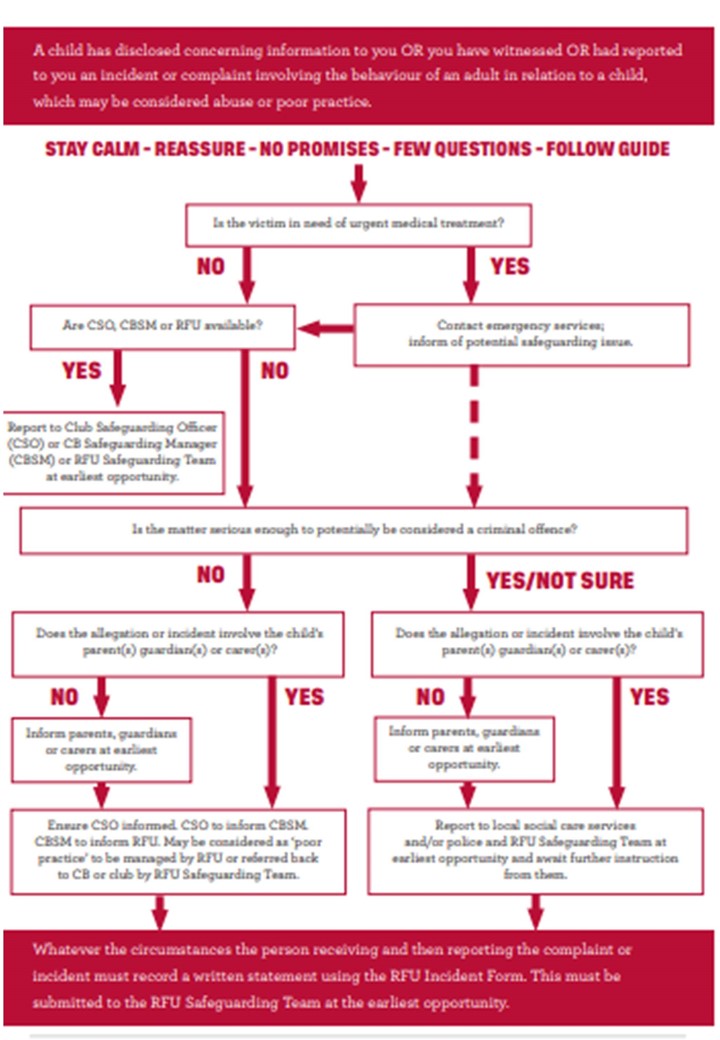
Please refer to the flowchart for the steps to be followed. The flowchart does not distinguish between the environment in which the concerns arise whether inside or outside the rugby environment. It is also appropriate to follow this procedure for allegations of abuse by one child against another.
Signs of Harm - It is important that in the rugby environment signs of harm are not ignored. These signs may include a child:
- changing their usual routine
- beginning to be disruptive during sessions
- becoming withdrawn, anxious or lacking in confidence
- having possessions going missing
- becoming aggressive or unreasonable
- starting to stammer or stopping communicating
- having unexplained cuts or bruises
- starting to bully other children
- being frequently dirty, hungry or inadequately dressed
- displaying sexual behaviour or using sexual language inappropriate for their age
- seeming afraid of parents or carers
- stopping eating
- being frightened to say what’s wrong
- not wanting to attend training or club activities, or even leaving the club
Abuse should always be taken seriously, and any concerns should be reported to the CSO. In their absence the CBSM or RFU Safeguarding Team should be informed at the earliest possible opportunity. Any report must be made in writing using the RFU Initial Issue/Concern Reporting Form. The Reporting Form may be found at
www.englandrugby.com/governance/safeguarding/ reporting-an-issue along with the contact details for all the Safeguarding Team.
Dealing with Concerns - Any member of the children’s workforce who suspects abuse or neglect or hears a complaint of abuse or neglect:
- should listen carefully to the child and keep an open mind. They should not take a decision as to whether or not the abuse has taken place;
- should not ask leading questions, i.e. a question which suggests its own answer;
- should reassure the child but not give a guarantee of absolute confidentiality. The adult should explain that they need to pass on the information in accordance with this policy so that the correct action can be taken; and should keep a sufficient written record of the conversation. The record should include: (i) the date and time; (ii) the place of the conversation; and (iii) the essence of what was said and done by whom and in whose presence;
- and should be signed by the person making it, using names and not initials.
All other evidence, for example, scribbled notes, mobile phones containing text messages, clothing, computers, should be kept securely with the written record (see below) and passed on when reporting the matter in accordance with this Policy
Recording the Concern All concerns about a child should be recorded in writing. Records should be factual and signed and dated, with the name of the signatory clearly printed in writing. Records should include • the child’s details: name, date of birth, address and family details;
- date and time of the event / concern;
- the action taken and by whom;
- the name and position of the person making the record
An individual who becomes aware of any suspicions or concerns about the safety or welfare of a child should pass these on to the CSO as soon as possible. If they feel the child is in immediate risk of abuse, then a statutory agency (local children’s services or the police) should be contacted immediately. Otherwise, the CSO must contact the RFU Safeguarding Team or if they are not available the CB Safeguarding Manager to report the matter or discuss how to proceed.
How the RFU will respond to suspicions or concerns - The RFU encourages and supports “whistleblowing” and will, where appropriate, notify the statutory agencies of any allegation and work in partnership with them. RFU investigation will usually commence once the statutory agencies have completed their investigations and referred the case back to the RFU. The wellbeing of the child must be central to any procedures involving them. The RFU will work in partnership with local children’s services and rugby clubs to support the victim and witnesses.
Incident referral process - Regulation 21 requires all incidents, suspicions, and concerns regarding a child to be reported to the RFU Safeguarding Team as soon as possible. Once the RFU Safeguarding Team receives written notification of an incident, allegation, or disclosure it will assume management of the case. If the case is being investigated by the police, the RFU Safeguarding Team will liaise with them and discuss whether or not to proceed with RFU disciplinary action prior to or alongside the police investigation. The matter may also be referred to the DO (Designated Officer previously referred to as the Local Authority Designated Officer, LADO, many LAs still use this acronym) where there is an allegation made against staff or volunteers who work with children. The DO will manage the allegation and provide advice, manage the case and liaise with other agencies such as the police.
Once the RFU receives a concern, the club should take no further action until advised to do so by the RFU or relevant authority. The RFU will ensure that the club and Constituent Body are kept informed of procedure and progress.
Safeguarding investigations are handled by the RFU Safeguarding Team and presented to the RFU’s Referral Management Group (RMG) for consideration. The RMG is a cross-departmental group charged by the RFU with assessing the risk that individuals pose to children. Incidents may be referred by the RMG to the RFU discipline department.
Those under investigation - Under this policy the RFU is committed, first and foremost, to protecting the interests of the child. In the course of a referral being made to the RFU or statutory agencies, individuals who are accused of causing harm will be informed of the procedures by the RFU. They may also request at any time an update on the progress of the referral. Investigations are concluded as quickly as possible to ensure that those guilty of causing harm are dealt with expeditiously and those falsely or mistakenly accused are able to return to the game with reputation intact.
Barring from rugby union- A bar may be issued by the RFU Legal Officer in accordance with RFU Regulation 21. Please refer to the RFU Regulations found in the RFU Handbook or at englandrugby.com/regulations for further information. The RFU has established clear processes for the handling of complaints, incidents, problems and enquiries. These are set out in RFU Regulation 21.
Complaints - If you have a complaint in relation to a safeguarding process undertaken by the RFU, the RFU’s safeguarding complaints procedure can be found at: www.englandrugby. com//dxdam/45/4561a7c8-9e50-462080bf-9711a26d044e/ RFUSafeguardingComplaints.pdf
Appendix A - RFU Safeguarding Toolkit Season 21/22, August 2021 (version 1) (Refer separate attachment)
